
I have been reading the steady stream of AI use cases across LinkedIn, Substack, industry reports and research papers. Some of it is genuinely useful. Some of it feels familiar in a way I cannot quite place. Some of it is scaremongering. Some of it repackages old promises in new language. And some of it insists the future has already arrived, with the rest of us merely needing to catch up.
Reading these posts, I keep returning to a question I have been carrying around for better part of my professional career:
when will the long-cherished promise of better executive decision-making, that bridges the gap between strategy & execution, actually be delivered?
I lived through three parallel waves of promises.
First, I lived through multiple waves of Decision Support & Business Intelligence Systems. I lived through Business Objects, Informatica, Cognos, SAS, SPSS. I lived through the predictive intelligence promise and the semantic search promise, where systems were supposed to know what we meant rather than what we typed. I lived through data warehouses, then data marts, then data mining, then data lakes, then data streaming. All are good to some extent, they did a good job when implemented properly. Each wave promised that better data infrastructure would lead to better decisions. Each was followed by another wave promising much the same thing in different packaging.
The same period saw a procession of packaged technology solutions, each of which promised in isolation to bridge strategy and execution there by improving decision making across the board. PPM tools (Jira, Planview, Clarity, Planisware, Primavera etc.) claimed it. ERP and CRM tools / solutions claimed it.
Anther third was packaged management thinking / solutions. Every transformation label of the moment claimed it: Digital Transformation, Finance Transformation, Operating Model Transformation, and now AI Transformation. Delivery frameworks claimed it. Value stream consultancies claimed it. Strategy execution tools claimed it.
All three things were true at the same time: management thinking kept advancing, technology and tooling kept advancing, organisations kept investing heavily in capability and process modernisation. And yet executive decision-making still suffers.
The gap between strategy and execution stays open. In most organisations, the practical integration layer is still Excel, PowerPoint, emails and manually curated reporting packs.
That is not because people love manual reporting. It is because organisational reality is messy. Data is structured and unstructured at the same time. It is fragmented across systems of record, systems of engagement, systems of work, and local workarounds. That structured data alone is not sufficient. Data required for decision-making is deeply contextual.
The most important transformation signals often sit in meeting notes, board papers, risk logs, delivery narratives, decisions, assumptions, dependencies, customer feedback, and operational exceptions. They do not live only in tidy database fields.
Excel and the infamous VBA macro filled this void. Sometimes this Excel & VBA combo is disguised as "SharePoint Lists with Power Query". Even after tens, sometimes hundreds, of millions of pounds were spent on enterprise tooling, organisations still reached for spreadsheets and slide decks to reconcile what the official systems could not.
Grenville Croll’s 2009 paper "Spreadsheets and the Financial Collapse" argued that spreadsheet dependence and weak spreadsheet controls were not trivial back-office issues, but part of the fragile decision infrastructure around the financial system. - Barclays and Lehman anyone?
Some latest horror stories are available here: https://eusprig.org/research-info/horror-stories/
The trouble was never only technical. It was also conceptual. Most management systems still assume a level of linearity that does not exist. Strategy, a part flows into BAU operational work and another is translated into change portfolios, portfolios into programmes, programmes into projects, projects into deliverables, and deliverables into benefits, but visibleon the BAU / run side long after these change initiatives are closed and teams dispersed. On paper this looks sensible.
In practice, cause and effect are difficult to prove. Dependencies move. Assumptions expire. Decisions compound. Operating conditions change. Value leaks across the boundary between change-the-business and run-the-business.
The result is a familiar pattern:
- organisations produce more reports, but do not necessarily gain more insight
- they track more activity, but do not always understand how value is flowing
- they make hundreds of decisions, but struggle later to reconstruct why those decisions were made, what assumptions they relied on, and how they affected value realisation
- they govern inputs, milestones and spend, but discover strategy drift too late
So the real question is whether something has changed.
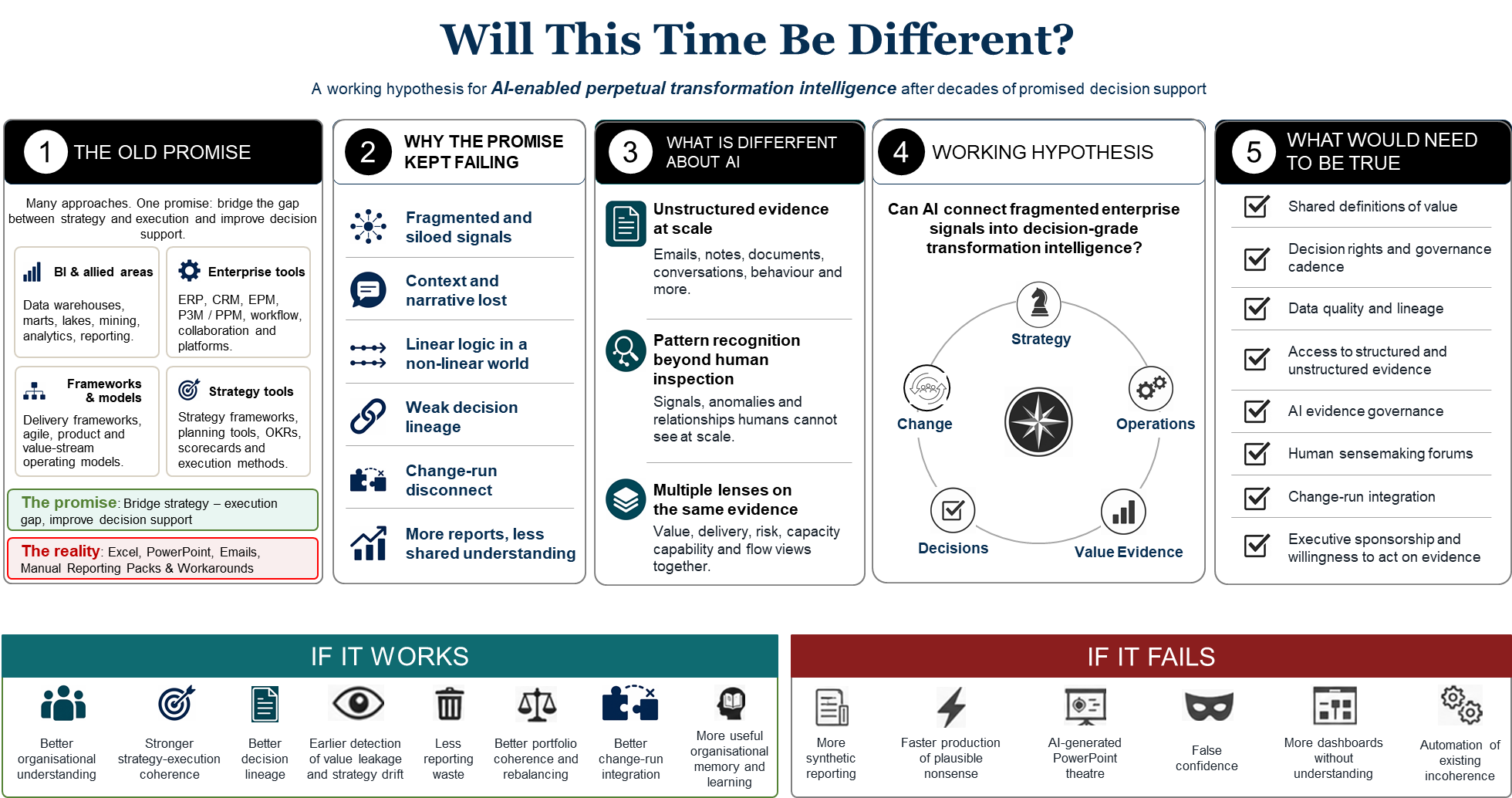
AI and LLM tools appear to differ in some specific ways from earlier waves. They handle unstructured text at scale. They can ingest meeting notes, board papers, contracts, exceptions and customer signals alongside the structured operational data earlier tools were limited to. They can recognise patterns across volumes of evidence no human cohort could realistically inspect. They can hold multiple lenses on the same evidence at the same time.
If those capabilities are real, then a question worth posing to the practitioner community is this: can we finally close a gap that BI, data warehousing, decision support systems and packaged enterprise applications have not closed? Or are we about to add another label to the pile?
I want to pose this question rather than answer it. Here is my working sketch on the challenges and what we need to have in place to solve.
In practical terms, that would mean using AI and LLMs to:
- bring unstructured data into decision-making at the same evidential weight as structured data
- recognise patterns across hundreds or thousands of decisions, artefacts and signals that no human cohort could reasonably see
- trace the lineage between strategic intent, investment choices, delivery activity, operational adoption, impact measurement and realised value
- test cohesion across a portfolio, asking whether one investment is undermining, duplicating or constraining the value expected from another
- see how decisions made last year are shaping value realisation today
- detect causal patterns visible only after implementation, where the assumptions baked into the original business case can finally be tested against what actually happened
- reopen the lessons-learned graveyard and turn it into a living organisational memory rather than an archive nobody reads
- surface weak signals of strategy drift, value leakage, adoption failure or dependency stress before they become obvious on a board or ExCo agenda
- support continuous portfolio rebalancing rather than the annual ritual it usually is
None of this is a claim that AI replaces accountable human judgement. The opposite. The purpose is to improve the quality of human judgement by giving leaders better lineage, better context, better evidence and better feedback loops.
The hard work remains organisational: defining value, clarifying decision rights, improving governance cadence, connecting change and run, designing operating models that can keep evolving.
The hope is, AI might finally help address a problem that earlier generations of BI, data warehousing, decision support systems and packaged enterprise applications never fully solved: connecting fragmented enterprise signals into decision-grade transformation intelligence.
Three questions worth your time:
- Where do you see the strongest use cases for this?
- Where do you think it overreaches?
- And what would need to be true for this to work in a real organisation, rather than only on a diagram?